
From Guard Card to Armed Security: A MASE Career Report
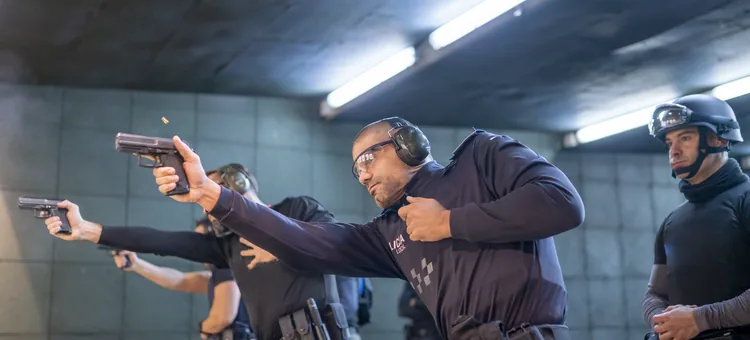
Firearms training prepares a security professional for the responsibilities of a role that involves carrying a firearm. It adds legal accountability, safety requirements and recurring qualification to the communication, observation and reporting skills expected of every guard. Completing a course is one part of that pathway; it does not automatically authorize armed work or guarantee a higher-paying assignment.
A Guard Card, a baton permit and an exposed firearms permit are separate qualifications. Choose additional training around a verified job requirement, your readiness and the full cost of maintaining that qualification. Open the MASE pay comparison charts and career pathway report.
What does firearms training mean in California?
BSIS requires eligible applicants to complete approved firearms instruction, a written examination and range qualification. Initial eligibility includes being at least 21, lawful firearm eligibility, qualifying registration or licensure, background checks and an application. Guard registrants also need the applicable judgment, restraint and self-control assessment. Confirm your eligibility and the application sequence with BSIS before paying for a course. BSIS firearms requirements.
Training is about safe, lawful decision-making and professional responsibility. Ask an approved instructor how the course covers the law, safe handling, accountability and qualification. This page is career information, not instruction in using a weapon. A good training decision starts with the question: does this specific position actually require armed duties?
The next step after a general Guard Card
Begin with the Guard Card pathway and required ongoing training. Build dependable attendance, accurate incident reports, calm communication and knowledge of site procedures. Review actual job descriptions with an employer before selecting a specialist permit. An experienced unarmed officer can also progress into supervisory, dispatch, monitoring or training-support roles without becoming armed.
For an armed role, verify training-provider credentials, eligibility and all required approvals, then complete employer screening and site onboarding. An exposed permit applies only to its associated license and listed calibers. It does not itself authorize concealed carry. The permit lasts two years; renewal includes four appropriately spaced qualifications and required review training. Check BSIS permit scope and renewal rules.
How much could your pay increase?
There is no verified statewide average increase attributable solely to a firearms permit in the evidence reviewed for this report. BLS combines armed and unarmed security guards. Its May 2025 national median for security guards is $38,020 annually, with the bottom ten percent below $30,210 and the top ten percent above $58,840. These are broad occupation benchmarks, not Sacramento armed-job rates or MASE offers. BLS wage evidence.
Compare two written offers with similar location, hours, experience requirements and benefits. For example, moving from $20 to $24 per hour is a $4 difference, or 20 percent. That is a calculation example, not an average or a promised raise. The accompanying charts label hypothetical comparisons clearly. Shift premiums, overtime, insurance, travel, equipment and recurring training costs can change the value of an offer.
Which jobs may use firearms qualifications?
Armed guarding: Some contracted posts require an armed officer and additional screening. Confirm duties, supervision and the employer's post orders. Armored transport: Cash and valuables transport may involve armed roles, driving requirements and employer-specific procedures; a firearms permit alone is not a complete qualification.
Executive protection: Protective work may involve discretion, planning, communication and substantial experience. Some assignments are unarmed. Carry permissions and additional requirements depend on the specific duties and jurisdiction. Celebrity involvement is not evidence of a contract or endorsement.
Churches, synagogues and other houses of worship: A protection plan should reflect the congregation's needs, visitor welcome, event size, emergency coordination and leadership decisions. An assessment may recommend unarmed personnel, monitoring, access management or an appropriately licensed armed assignment. Do not assume that a particular faith community needs firearms or that a permit makes an individual qualified to design its entire security program.
Baton training is its own pathway
A baton permit is separate from both guard registration and a firearms permit. BSIS identifies approved training and application requirements, including instructor certification and examination. The permit expires after two years and renewal includes a specified retraining requirement. Verify the current process rather than relying on older advice that a baton permit lasts indefinitely. BSIS baton fact sheet.
Ask MASE before choosing a course
MASE's coordinated training pathway begins with employment application and review. Eligible employees may ask about approved providers and role-specific preparation. This is MASE's business policy, not a rule that every Californian must first become an employee to seek training independently. Instructor credentials, course availability, fees and any support arrangements require confirmation. Employment, permit approval and assignments are not guaranteed.
Use the existing inquiry form below to ask about prerequisites and the next suitable step. Request the full cost, renewal obligations and whether a current opportunity requires the qualification. Do not send identity documents or sensitive background details through a general inquiry. Report reviewed October 8, 2026.



